Top Signs You Need Garage Door Service – Don’t Ignore These
The clearest signs you need garage door service are a door that opens slowly or unevenly, a loud bang followed by a door that won’t lift, grinding or scraping sounds, reversed or flashing safety sensors, and visible cable fray or bent track. A slow door usually means the opener is compensating for a mechanical problem elsewhere, not a weak motor. If you’d rather not climb a ladder to investigate, call (855) 337-1035 and we’ll sort out what’s actually failing.
Most homeowners treat garage door symptoms as a flat checklist. We think that’s backwards. A symptom is a signal from one specific subsystem, and where that signal sits tells you how far along the failure is and how fast you need to act. That mental model is what this post gives you.
Why Your Garage Door Feels Slow (It’s Rarely the Opener)
A garage door that opens more slowly than it used to is usually fighting resistance, not losing motor power. The opener draws more current to push through that resistance, which heats the motor and shortens its life. Left alone, a sluggish door becomes a burned-out opener within months, and now you’re paying for two repairs instead of one.
The resistance almost always comes from the spring and balance system. When a torsion spring loses tension, the door becomes heavier than the opener is rated to lift. Worn rollers, dry hinges, or a track that’s out of plumb add drag on top of that. In Ironbound, freeze-thaw cycling through winter works springs and bottom seals harder than in milder climates, so a door that ran fine in October can feel noticeably stiff by February.
What we check first: door balance with the opener disengaged, spring tension, roller condition, and hinge lubrication. If the door won’t hold halfway open by hand, the spring is the culprit and the opener is the victim. That’s a repair, not a replacement, and it’s worth catching early. Our garage door repair service covers exactly this kind of diagnostic work.
Springs and Cables: The Subsystem That Demands Same-Day Attention
A snapped torsion spring announces itself with a sharp bang, and the door won’t lift afterward. That is a same-day call, not a wait-and-see. A cracked or broken spring means the door is being held by the opener alone, and running it in that state can bend the door, snap a cable, or damage the motor.
Cables are the quieter hazard. Frayed strands, a cable that’s jumped its drum, or one that’s gone slack all point to a system under abnormal load. Cables are under extreme tension and can cause serious injury if handled without the right tools and training. We don’t recommend DIY on springs or cables under any circumstances. This is why spring repair is a core service for us rather than an afterthought: it’s the most dangerous job on a garage door, and it’s the most commonly mishandled.
Signs that put you in the same-day category in Ironbound:
- A loud pop or bang followed by a door that won’t open
- A visible gap in a torsion spring coil
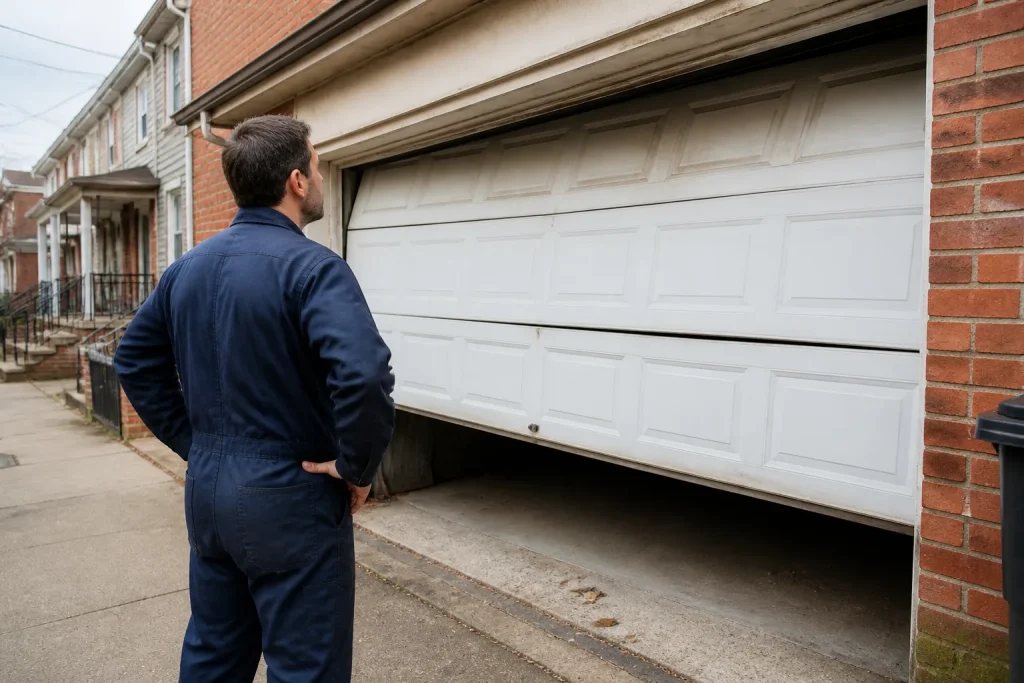
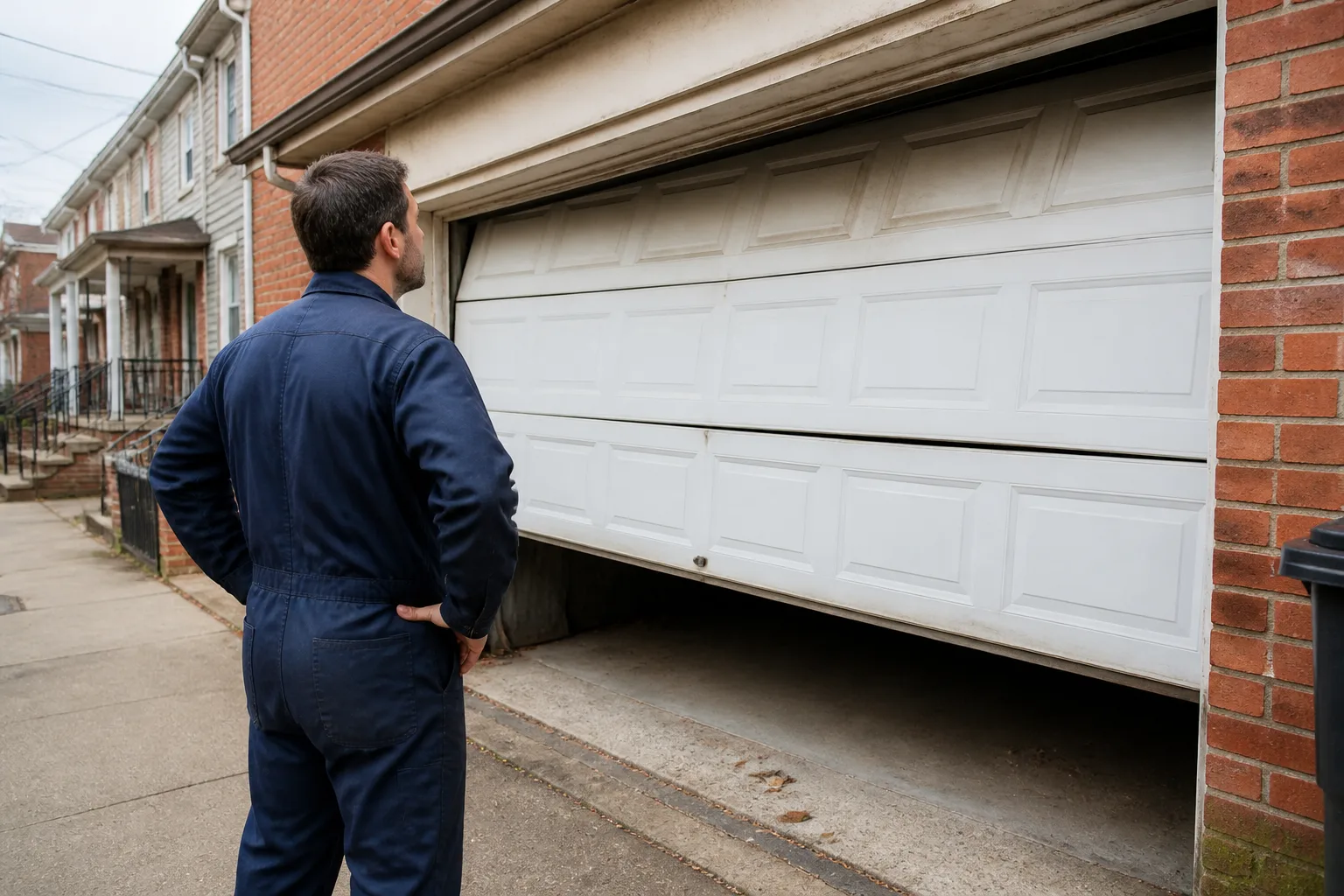
- A door hanging crooked, with one side higher than the other
- Frayed or kinked cables, or a cable off its drum
- The door slamming down instead of lowering smoothly
If any of these are happening, stop operating the door and call. Our garage door opener repair and spring work are often booked together for this reason.
What the Sound Is Telling You (By Component)
Homeowners usually hear a problem before they see one. The type of sound narrows down which part is failing.
- Grinding: usually dry or worn rollers, or a torsion spring that’s lost lubrication and is binding. Grinding that gets worse over weeks is a roller and hinge issue.
- A sharp pop or snap: a broken torsion spring. This is the loudest and most urgent one.
- Scraping: the door panel rubbing the track, often from a bent track section or a misaligned roller. Scraping also happens when a bottom seal drags on the floor.
- A rattling or banging while the door moves: loose hinges, brackets, or a track that’s worked itself out of alignment.
- A hum with no movement: the opener motor is running but the drive isn’t engaging – a stripped gear, a broken belt, or a dead capacitor, depending on the unit.
Brand matters here. A LiftMaster or Chamberlain unit hums differently than a Genie or a Clopay door with a screw drive. Being familiar with those systems means we know what a healthy one sounds like before we start troubleshooting.
The Secondary Failure Problem (Why Ignoring One Sign Costs More)
A worn roller seems harmless. It isn’t, because every symptom you defer loads strain onto a component that wasn’t designed to carry it. Worn rollers force the opener to work harder, which wears the motor. A dragging door strains the cables, which can snap. A misaligned track wears the rollers faster. Each deferred fix compounds the next.
This is the real cost of waiting. A set of rollers and a hinge lubrication is a minor repair. A burned-out opener, snapped cable, and bent bottom section is not. In Ironbound, where humidity and seasonal swings put extra stress on hardware, the compounding happens faster than homeowners expect.
Some symptoms can wait a few weeks while you monitor them: a noisy roller, a slightly stiff hinge, a door that’s a little louder than it used to be. Others can’t. Cracked springs, frayed cables, and a door that won’t stay closed are same-day. The line between them is simple: if the door is unsafe to operate, it’s not a monitoring situation.
Tracker, Sensor, and Panel Signs You Shouldn’t Skip
Safety sensors are the most common reason a door refuses to close. If the door reverses immediately or the sensor light flashes, something is blocking the beam or a sensor is misaligned. That’s usually a quick fix, but a door that won’t close at night is a security problem, so don’t leave it.
On the panel side, look for dents, cracked sections, and a bottom seal that’s torn or flattened. In Ironbound, freeze-thaw cycles and summer humidity are hard on wood door sections: paint peels, wood swells and warps, and the door stops sealing properly. Metal panels handle it better but still show rust at the seams when moisture sits. If the door is visibly bowing or a panel is separating, it’s time for a professional look.
When to Call a Pro
Call us if the door won’t balance by hand, if you hear a pop, if a cable looks frayed, or if the opener hums without moving. Those are the situations where a quick visit saves you a bigger repair. If it’s just a noisy roller, you can note it and book a maintenance visit when convenient. For emergency situations, we offer dedicated emergency garage door service, and the price is quoted before any work begins, so there are no surprises on the invoice.
Related services in Ironbound: garage door installation if the door is past repair, and Garage Door Repair Ironbound for the full service lineup.
The Bottom Line
Treat symptoms by subsystem, not as a flat list. Slow doors point to springs and balance. Pops and crooked doors are emergency-tier. Grinding and scraping are usually rollers and tracks. Humming without movement is the opener. The cheapest repair is the one you do before the deferred symptom causes a secondary failure. Our technicians have up to 9 years of experience across all the major brands. If you’re in Ironbound and need help, Garage Door Repair Ironbound offers free estimates – call (855) 337-1035.
Frequently Asked Questions
Maintenance covers lubrication, roller inspection, and balance checks on a functioning door. Repair is needed when the door won’t open, won’t close, makes a pop or grinding sound, or moves unevenly. If the door still operates smoothly and quietly, maintenance is enough. If any function is compromised, it’s a repair.
No. Torsion springs are under extreme tension and can cause serious injury if handled without proper tools and training. This is a job for a trained technician with the right equipment. Our team handles spring repair as a standard service.
A noisy roller or hinge can usually wait a few weeks while you monitor it, but not indefinitely. Noises tend to worsen and strain the opener over time. If the noise is a pop or snap, don’t wait at all.
We work on the major brands, including LiftMaster, Chamberlain, Genie, Clopay, Amarr, Wayne Dalton, Craftsman, and Raynor. Being familiar with each system means we diagnose faster and get the right parts the first time.
Written by the team at Garage Door Repair Ironbound.
Need Garage Door Help?
Call Garage Door Repair Ironbound - the local pro we connect you with is licensed and insured, here with fast after-hours help in Ironbound.
(855) 337-1035