Garage Door Repair: Repair or Replace? How Ironbound Homeowners Decide
Most homeowners compare the price of a repair to the price of a new door and stop there. That math is incomplete. The real question is how much service life is left in the hardware you already own. If a spring is tired, the rollers are flat-spotted, and the bottom seal is crumbling, a $400 fix buys you a few months before the next bill shows up. If the rest of the system is sound, that same $400 is money well spent. Here’s how Ironbound homeowners can work through that call without a sales pitch in their ear.
A repair or replacement decision comes down to three things: the age of each component, the type of failure, and the total cost of ownership over the next five years. A door that fails on one worn part with otherwise healthy hardware is a repair. A door where several components are all nearing end of life is usually a replacement, even if the immediate fix looks cheap.
If you’d rather have a trained eye walk your door and give you a straight answer, call (855) 337-1035. Estimates are free, and we won’t push a replacement you don’t need.
Why the repair-versus-replace math trips people up
The usual mistake is comparing a repair quote to a sticker price for a new door. That comparison leaves out the install, the disposal of the old door, and – most importantly – the service life still sitting in your current panels, track, and opener. A repair that only postpones a bigger bill isn’t a saving. A repair that keeps a healthy system running for years is one of the better returns you’ll get on a home.
We work with every major brand – LiftMaster, Chamberlain, Genie, Clopay, Amarr, Wayne Dalton, Craftsman, and Raynor – which means we’re not guessing about what’s inside your door or whether parts are still made for it. That brand familiarity also changes the answer sometimes. A Clopay or Amarr door with a standard panel and a live parts catalog is a good repair candidate. A discontinued opener platform with no support is a different conversation.
Before you decide anything, you need an honest account of what’s actually wearing out. That’s the component-age audit, and it’s the subject of the next section.
The component-age audit: what to check before you decide
A component-age audit means looking at each part of the door and asking how much useful life it has left. Springs, rollers, opener motor, and panels all wear at different rates. One failing doesn’t mean the others are close behind, and one healthy part doesn’t mean the rest are fine. Check them together, then decide.
- Springs (cycle count). Torsion springs are rated by cycles, roughly one cycle per open and close. A door that runs several times a day burns through that rating much faster than a door used twice. A spring near the end of its rated life is a replacement item, and a matched pair should usually go together.
- Rollers (the mileage equivalent). Steel rollers wear flat and rumble; nylon rollers wear quieter but still wear. Rollers past their useful life add strain to the whole system and make a door sound worse than it is.
- Opener (motor hours). A modern Genie or Chamberlain unit with a healthy motor and a good logic board is worth repairing. A unit that’s been through years of daily cycling and needs a motor or board replacement is often better swapped for a current model.
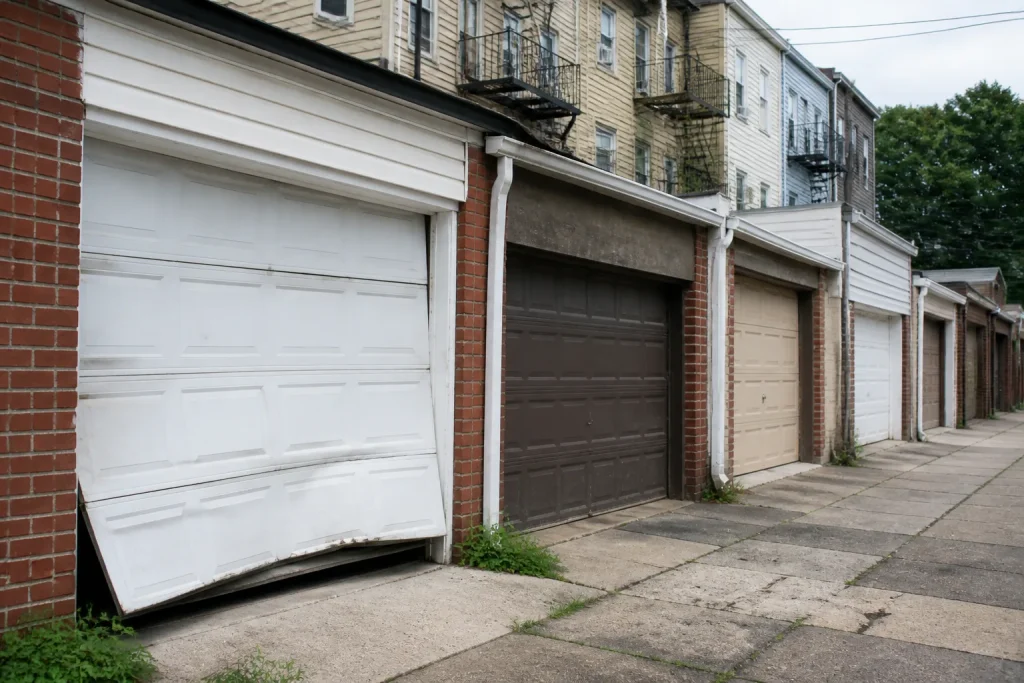
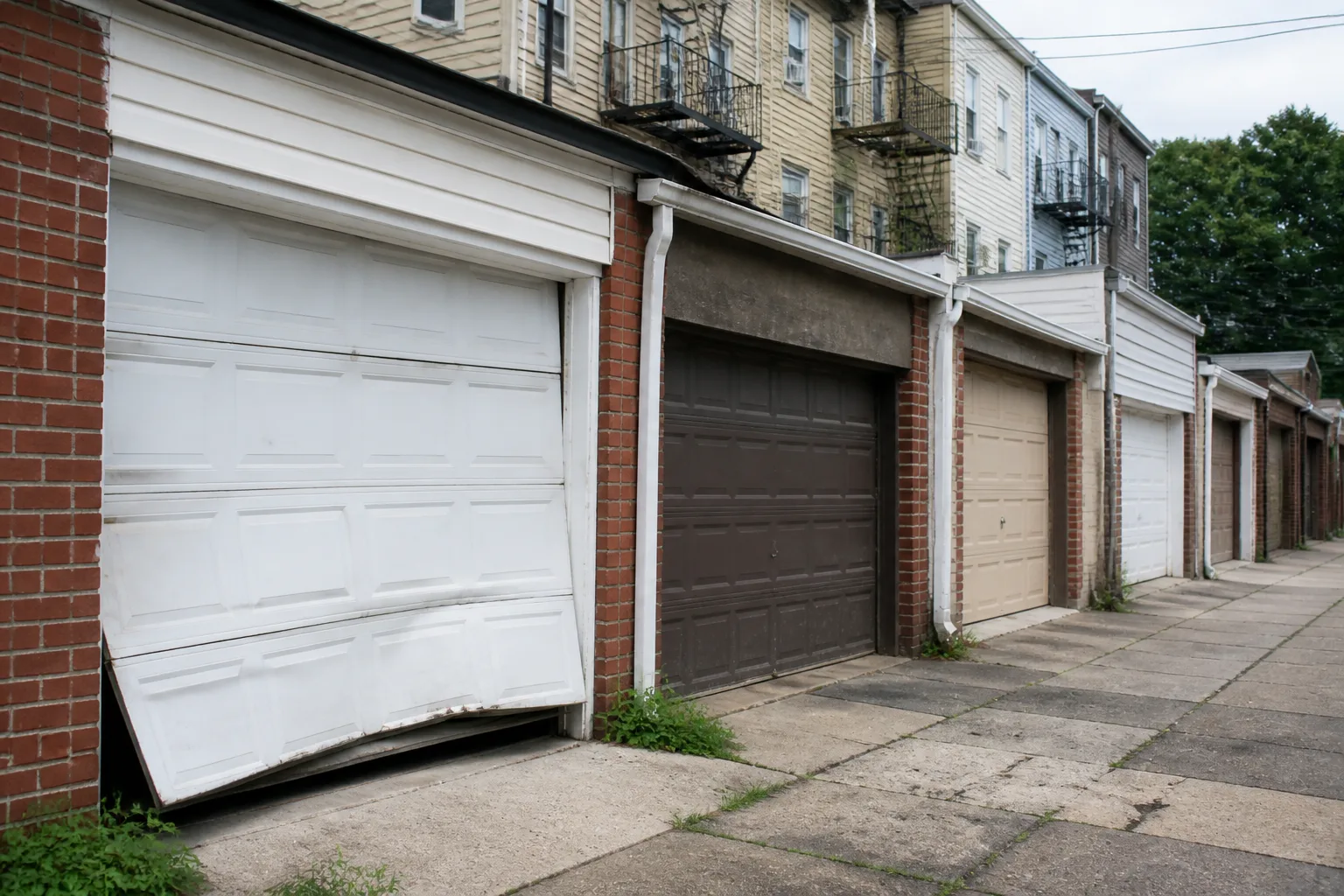
- Panels (surface and structural integrity). Surface wear you can live with. Dents, rust through the steel, or a bent panel that drags on the track are structural, and those are the cases where replacement usually wins.
Once you’ve tallied those four, you can see whether you’re fixing one thing or patching several.
Repair as a bridge cost versus repair as a resolution
Not all repairs are equal. Some resolve the problem; others just delay the next one. Telling the difference is the whole game.
A repair is a resolution when the failure is isolated. One worn spring on a door with good panels, sound rollers, and a healthy opener is a clean fix. You pay once, the door runs for years, and the repair was money well spent. A repair is a bridge cost when you’re papering over a system that’s already failing in several places. Fix the bottom bracket now, the rollers next, the opener after that, and you’ve spent more over a year than a replacement would have cost you in the first place.
Here’s the plain way to tell: if you’re fixing one thing, it’s usually a resolution. If you’re fixing three things in the next twelve months on a door that’s past its service life, the repair is really a bridge. That’s when it pays to look at the whole picture instead of the next invoice.
We’ve seen plenty of doors in Ironbound where the honest answer was repair, and plenty where the honest answer was replace. The door tells you which one it is – if you know what to look for. Our technicians have up to 9 years of experience reading exactly that.
The financial calculus for Ironbound homeowners
Ironbound homes sit close together, with attached garages that share a wall with the living space and often face directly onto the street. That geometry compresses three financial factors at once: curb appeal, energy, and security.
Curb appeal matters because a garage door is the widest visible face of most houses in the neighborhood. A worn, dented, or faded door drags the whole facade down with it. A clean, well-fitting replacement door lifts it – and that’s the kind of improvement buyers and appraisers notice, because it’s the first thing they see. We’re not going to quote you a percentage return, because those numbers vary street by street. But a door that’s visibly past it doesn’t help the house sell.
Energy matters because an attached garage is a big uninsulated wall between your living space and the outside. A door with failing seals, a warped bottom edge, or thin single-layer panels leaks air and heat year-round. A current insulated door tightens that wall and can pay you back on utility bills, especially through a cold New Jersey winter and a hot summer. That’s a quiet, ongoing return that a repair-only approach won’t capture on an already-tired door.
Security matters in a dense urban setting, where an attached garage is often the main access point to the house. A door that binds, reverses without command, or won’t close all the way is a security problem, and a new door with a modern opener solves it in one stroke. For anyone in Ironbound weighing repair against replacement, those three factors together – curb appeal, energy, security – tip the balance more often than the raw sticker price does.
When replacement wins outright
Some doors give you a clean answer: replace, regardless of what the repair quote looks like. Here’s what puts a door in that category.
- Structural panel damage. A bent, buckled, or rust-through panel changes how the door tracks and stresses the hardware around it. Patching panels on a structurally compromised door just moves the failure somewhere else.
- Discontinued opener platforms with no parts support. If the opener’s logic board or motor can’t be sourced, every future repair gets harder and more expensive. A current Genie or Chamberlain platform with smart-home support is a straight upgrade.
- Non-standard hardware that keeps driving up service costs. Odd track profiles, obsolete torsion systems, and custom brackets add labor and part-hunting to every visit. On a door that needs frequent service, standard hardware is cheaper to own over five years.
- The 50% rule. Borrowed from HVAC and applied here: when a single repair costs more than half the installed price of a new equivalent door, replacement typically wins on a five-year horizon. Compare installed price, not sticker price, because installation and disposal are part of the equation.
When you’re ready to price a replacement, we handle garage door installation for every brand we service, and we’ll give you an installed number up front, so you can run the 50% rule honestly.
When to call a pro, and related services in Ironbound
Most of the audit is safe to do standing back and looking. Springs are not. A torsion spring carries serious stored energy, and the cables under tension can cause real injury if they let go during a DIY attempt. If a spring is broken, don’t try to move it – call a trained technician.
An opener that reverses unpredictably, a door that won’t close all the way, or a door that’s come off its track are all calls for a pro. That’s also when garage door opener repair comes in, because a lot of “door problems” turn out to be an opener or safety-sensor fault, not a door fault. If your door isn’t staying down at night, that’s the kind of thing worth fixing sooner rather than later.
For anyone who wants the whole system looked at – door, springs, opener, and track – the team at Garage Door Repair Ironbound has you covered under one roof. If you already know the door’s past saving, we can talk through replacement options the same week, and for emergencies we run a dedicated garage door repair line with same-day response. Spring repair is a standard part of what we do, not an afterthought – and yes, we’ve heard every “I’ll just pull it up by hand” story there is. Please don’t.
What happens when you call
- 1
A real person answersNo phone trees – you reach a local pro.
- 2
You get an upfront price rangeHonest numbers before anyone is dispatched.
- 3
A background-checked tech heads outLicensed & insured, dispatched right away.
- 4
You approve before work beginsNothing starts until you say go.
The Bottom Line
Repair or replace comes down to your component-age audit, the type of failure, and the total cost over the next five years. If one part has failed on otherwise sound hardware, repair it. If several components are nearing end of life, or the repair costs more than half the installed price of a new door, replacement usually wins. Don’t compare a repair quote to the sticker price of a new door; compare it to the installed cost and to what you’ll spend keeping the old one alive.
If you’re in Ironbound and need help, Garage Door Repair Ironbound offers free estimates – call (855) 337-1035. We’ll walk your door, tell you what’s actually wearing out, and give you a straight answer either way.
Frequently Asked Questions
Start with a component-age audit: check springs, rollers, opener, and panels. If only one part has failed and the rest is sound, repair. If several are near end of life, or the repair costs more than half the installed price of a new equivalent door, replacement usually wins. Call (855) 337-1035 for a free estimate and a second opinion.
It depends on what’s failed and your door’s brand and size. Springs, rollers, and opener fixes have different parts and labor costs. The written estimate sets the final price, and we quote before any work starts so there are no surprises. Call (855) 337-1035 for an exact figure on your door.
Only if the audit says so. A single panel or spring failure on a 12-year-old door with healthy hardware is usually worth repairing. If the springs are near their cycle limit, rollers are worn, and the opener is struggling, replacement can cost less over five years than repeated fixes. Call (855) 337-1035 and we’ll tell you which case you’re in.
The local pro we connect you with is licensed and insured as their state requires. We can work with your insurer if you need to file a claim. Call (855) 337-1035 for a free estimate.
Written by the team at Garage Door Repair Ironbound.
Need Garage Door Help?
Call Garage Door Repair Ironbound - the local pro we connect you with is licensed and insured, here with fast after-hours help in Ironbound.
(855) 337-1035